
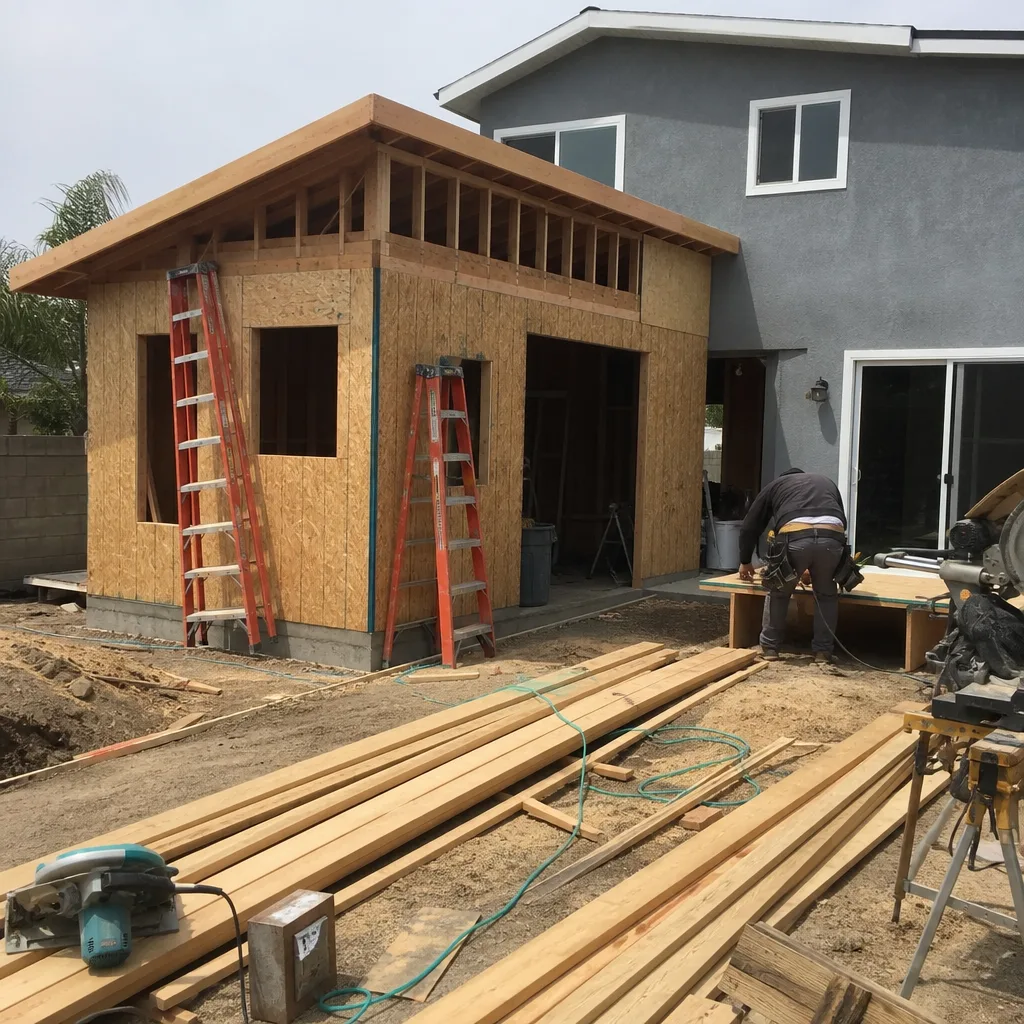
Last updated October 30, 2026
ADU Cost Breakdown: The Placentia Homeowner’s Reference for 2026
That “$150,000 to $350,000” ADU cost range you keep seeing quoted online is a statistical blur. It averages coastal Los Angeles with rural Fresno and suburban San Diego, which tells you almost nothing about what you’ll actually write a check for in Placentia. The truth is that Placentia’s cost floor sits measurably higher than the state average, and it has nothing to do with inflation or greedy contractors. It comes down to two structural realities: Orange County’s union-heavy skilled labor market and Placentia’s specific utility infrastructure, which we’ll unpack in detail below.
This guide covers what Placentia homeowners actually pay in 2026, where the money goes, which costs are non-negotiable, and which levers you control. If you’re comparing a Tuff Shed conversion against an Abodu unit against custom site-built construction, you’ll get real numbers, not aspirational ranges.
Quick Answer
In Placentia in 2026, a permitted ADU costs between $220,000 and $480,000 depending on build method and size, with prefab and modular units (Abodu, Cover, Mighty Buildings) typically landing at $280 to $420 per square foot and custom site-built construction at $350 to $550 per square foot. A basic Tuff Shed conversion can start around $80,000 to $120,000 for a studio. The two costs that surprise Placentia homeowners most are utility work (electrical service upgrades and gas meter upsizing) and site preparation, which together routinely add $25,000 to $60,000 before a single wall goes up.
Table of Contents
- What Actually Drives ADU Costs in Placentia
- Prefab vs. Site-Built: An Honest 2026 Cost Comparison
- The Fixed Costs No ADU Type Avoids
- The Levers You Actually Control
- Soft Costs: Design, Permitting, and Engineering
- Rental Income and Realistic Payback Periods in Placentia
- Common Mistakes to Avoid
- When to Call a Professional
What Actually Drives ADU Costs in Placentia
Placentia sits inland, about 12 miles from the coast. That matters more than you’d think. The city’s older housing stock, much of it built between the 1950s and 1970s, means the average home’s existing electrical panel and gas service were never sized for a second dwelling. When you add an ADU, the math changes: an electric range, water heater, HVAC system, and sometimes an EV charger all pull from the same service that’s been running a single house for 60 years.
Here are the Placentia-specific cost drivers we see on nearly every project:
- Southern California Edison (SCE) service upgrade: If your panel is 100 amps or less, which is common in older Placentia neighborhoods like the area north of Chapman Avenue, you’ll need a 200-amp upgrade. Budget $3,500 to $6,000 for the panel itself, plus another $1,500 to $4,000 if SCE needs to run a new service drop from the pole.
- Gas service and meter upsizing: Placentia uses Golden State Water Company for water, but natural gas is SoCalGas territory. Adding a gas range, tankless water heater, or gas dryer to an ADU often requires a larger meter. SoCalGas charges between $2,000 and $5,000 for a residential meter upgrade, and scheduling can add 6 to 10 weeks to your timeline.
- Grading and lot topography: Placentia’s terrain varies surprisingly. Homes in the Alta Vista area sit on noticeably sloped lots, which triggers grading and retaining wall work that flat-lot homes in the Atwood neighborhood never deal with. Grading alone can add $8,000 to $25,000.
- Setback and lot coverage realities: Placentia’s ADU ordinance follows state law but the city’s specific lot coverage maximums and setback enforcement mean that many 5,000 to 6,000 square foot lots simply can’t fit a 1,200 square foot detached ADU. Your realistic maximum is often 600 to 800 square feet, which changes the per-square-foot economics.
When we walk a Placentia property, the first 45 minutes are spent answering one question: what infrastructure is already here, and what has to change? That answer, more than any material choice, determines your true final cost.
Prefab vs. Site-Built: An Honest 2026 Cost Comparison
This is where most online guides fall apart. They quote prefab pricing from the manufacturer’s website, which covers the factory-built module only. Then they quote site-built pricing from a general contractor, which usually includes everything. You end up comparing apples to a basket of apples, delivery fees, and crane rentals.
Here’s what we’ve seen on actual Placentia projects in 2025 and 2026:
| Build Method | All-In Cost per Sq Ft | Typical Total for 600 Sq Ft | Construction Timeline |
|---|---|---|---|
| Tuff Shed conversion (studio) | $180 – $260 | $108,000 – $156,000 | 4 – 7 months |
| Abodu modular unit | $280 – $380 | $168,000 – $228,000 | 6 – 9 months |
| Mighty Buildings prefab | $320 – $420 | $192,000 – $252,000 | 7 – 10 months |
| Cover custom modular | $350 – $450 | $210,000 – $270,000 | 8 – 11 months |
| Custom site-built (stick frame) | $350 – $550 | $210,000 – $330,000 | 9 – 14 months |
Three observations from these numbers. First, the spread between the cheapest and most expensive option narrows considerably when you factor in site work, utility connections, and finishing. A Tuff Shed shell costs $25,000. A finished, permitted Tuff Shed ADU costs four to five times that. Second, modular timelines are not dramatically shorter than site-built in Placentia because permitting and utility coordination at the city and utility level take the same amount of time regardless of where the walls were built. Third, the real value of a system like Abodu or Cover is predictability: their costs are more contained because the manufacturing process removes weather delays and some labor variability.
We work with all of these systems, which means we can walk you through the trade-offs without trying to sell you on one. A homeowner who wants a rental-ready unit fast may find Abodu compelling. A homeowner with a tricky lot or an unusual design vision may be better served by site-built. Neither answer is wrong.
The Fixed Costs No ADU Type Avoids
Every ADU in Placentia, whether it arrives on a truck or gets framed on site, carries certain costs that have nothing to do with the building itself. Understanding these before you budget is the difference between a project that stays on track and one that bleeds money in change orders.
- Permitting and plan check: Placentia’s building department fees for an ADU run $4,000 to $8,000 depending on scope. This includes plan check, building permit, and inspection fees. It does not include school district fees, which Placentia-Yorba Linda Unified School District levies on new residential square footage at approximately $4 per square foot. On a 600 square foot ADU, that’s another $2,400.
- Utility connection fees: Placentia’s utility providers charge separately for new service connections. Water and sewer connection fees for a detached ADU typically run $3,500 to $7,500. Electrical service work, which we covered earlier, adds another $5,000 to $10,000 in most cases.
- Site preparation: Every ADU needs a foundation. For prefab units, that means a concrete pad or raised foundation system between $15,000 and $30,000. For site-built, you’re looking at $12,000 to $25,000. If your lot slopes, add grading costs on top.
- Fire sprinklers: If your primary residence has fire sprinklers, California law requires them in the ADU too. In Placentia, where many homes built after 1992 include sprinklers, this adds $6,000 to $10,000. Older homes without sprinklers in the main house don’t trigger this requirement.
- Solar readiness: California’s Title 24 energy code requires new ADUs to meet specific solar or energy efficiency standards. Depending on the unit’s orientation and your existing electrical setup, compliance adds $5,000 to $15,000.
These fixed costs add up to roughly $35,000 to $70,000 before you’ve made a single material choice. When a national cost calculator tells you an ADU costs $250 per square foot, it’s averaging these in unevenly. In Placentia, our fixed-cost reality is higher than state averages because of older housing stock and utility upgrade frequency.
The Levers You Actually Control
If the fixed costs are fixed, what’s left to negotiate with? More than most people think. Here are the five biggest levers we see Placentia homeowners pull, ranked by dollar impact:
- ADU size: Going from 800 to 600 square feet doesn’t just save 25% on construction. It can keep you under the threshold for certain utility upgrades, avoid additional parking requirements, and simplify setbacks. Size is the single highest-impact decision you’ll make.
- Build method: Choosing a Tuff Shed conversion instead of custom site-built can cut your total cost by 40% to 50%. Choosing Abodu over site-built saves 15% to 25% on most projects. The trade-off is design flexibility and long-term durability, which matters more for some homeowners than others.
- Interior finish level: A basic kitchen with stock cabinets and laminate counters costs $12,000 to $18,000. The same kitchen with custom cabinetry and quartz runs $25,000 to $40,000. Bathroom finishes swing similarly. We handle Bathroom Remodeling in Placentia and Kitchen Remodeling in Placentia as part of ADU interiors, so we can quote both ends of that spectrum honestly.
- HVAC system choice: A ductless mini-split runs $4,000 to $7,000 installed. A full ducted system costs $12,000 to $18,000. For ADUs under 700 square feet, the mini-split is almost always the right call in Placentia’s climate, where cooling demand dominates.
- Exterior materials: We build with James Hardie fiber cement siding on most of our projects because it holds up to Placentia’s summer heat and occasional Santa Ana winds without the warping or fading you see in vinyl. It costs 15% to 20% more than basic stucco or vinyl upfront, but the maintenance math flips within a decade.
Notice what’s not on this list: contractor markup. Placentia’s ADU market is competitive enough that most reputable contractors work within a 15% to 25% margin. The bigger savings come from the decisions above, not from beating down a bid.
Soft Costs: Design, Permitting, and Engineering
Online ADU calculators understate soft costs by 30% to 40%, consistently. These are the costs that don’t show up in material estimates or square footage math, but they land on your invoice the same way. In Placentia, here’s the real breakdown of soft costs for a typical detached ADU:
- Architectural and structural engineering: $8,000 to $18,000 for custom plans. Modular manufacturers like Abodu and Cover include basic design in their package, but site-specific engineering (foundation, grading, utility runs) is almost always extra.
- Survey and site plan: $1,500 to $3,500 for a boundary survey and topographic mapping. Placentia’s lot line documentation for older homes is sometimes outdated, and a survey catches encroachments before they become legal problems.
- Title 24 energy compliance: $800 to $1,500 for the mandatory energy modeling and documentation.
- Utility coordination: This is the line item nobody budgets for. Coordinating with SCE and SoCalGas for service changes, meter upgrades, and scheduling inspections requires someone to manage paperwork, wait on hold, and track timelines. We handle this in-house, but if you’re project-managing your own ADU, expect to spend 40 to 60 hours on coordination.
- Owner-occupied caveat: California requires that the property owner live in either the primary residence or the ADU. There’s no permit fee for this, but it does affect your financing eligibility and rental strategy, which we’ll get to.
The lesson here is straightforward: when someone quotes you an all-in ADU cost of $250,000, ask what’s included. If soft costs aren’t itemized, the real number is likely $300,000 to $320,000. A reputable contractor gives you a written line-item quote. If you’re comparing bids, ask for line items, not a single bottom-line number.
Rental Income and Realistic Payback Periods in Placentia
Placentia’s rental market in 2026 is shaped by Cal State Fullerton’s student population, commuters to Orange County’s medical and tech corridors, and growing demand from multigenerational families. That demand means stable rents, but the numbers still need to work against your construction costs.
Here’s what we see in three common scenarios:
- 400 square foot studio (Tuff Shed conversion, $110,000 all-in): Rents for $1,600 to $1,900 per month in Placentia. After property taxes, insurance, and maintenance, net annual income is roughly $15,000 to $18,000. Payback period: 6 to 7 years.
- 600 square foot one-bedroom (Abodu modular, $195,000 all-in): Rents for $2,100 to $2,500 per month. Net annual income is approximately $19,000 to $23,000. Payback period: 8 to 10 years.
- 800 square foot two-bedroom (custom site-built, $280,000 all-in): Rents for $2,700 to $3,200 per month. Net annual income is approximately $25,000 to $30,000. Payback period: 9 to 11 years.
These are longer payback periods than the 3 to 5 year returns some ADU marketing materials claim. Those claims usually ignore soft costs, utility upgrades, and realistic maintenance. A properly maintained ADU costs 1% to 2% of its value annually in upkeep, and that money comes out of your rental income.
That said, payback period isn’t the only metric. An ADU adds immediate resale value, typically 60% to 80% of construction cost in Placentia’s current market. If you’re planning to stay in the home for a decade or more, the ADU pays for itself through rent, adds resale value, and gives you flexibility for aging parents or adult children. If you’re planning to sell in 3 years, an ADU is harder to justify financially.
Common Mistakes to Avoid
- Budgeting from a national cost calculator: Those tools average labor costs across California. Orange County’s skilled trades command higher rates, and Placentia’s older housing stock means more frequent utility upgrades. Your real cost is 15% to 25% above the national average.
- Skipping the utility assessment before design: We’ve seen homeowners lock in architectural plans only to discover their electrical panel can’t support the ADU, forcing a redesign. Get your SCE and SoCalGas assessments done first.
- Choosing a lot coverage maximum ADU: Building the largest unit your lot allows maximizes square footage but often triggers grading, retaining wall, and setback variance issues that eat the savings from extra rent. A 600 square foot unit that fits cleanly is usually a better financial decision than an 800 square foot unit that requires $40,000 in grading.
- Ignoring owner-occupancy rules: California requires that either the ADU or the primary residence be owner-occupied. If you’re planning to rent both units immediately, you’re in violation, and that can affect your ability to secure financing and insurance.
- Treating prefab pricing as all-in: The manufacturer’s price for a module is not your total project cost. You still need foundation work, utility connections, permits, and interior finishing. Prefab is often cheaper than site-built, but not by the margin the brochure suggests.
- Assuming your contractor handles everything: Some general contractors sub out design, engineering, and utility coordination to third parties, adding markups and delays. Ask who handles these pieces before you sign.
When to Call a Professional
An ADU is not a weekend project. If your lot slopes more than a few feet, if your electrical panel is 100 amps or less, if your home sits in a designated historic district, or if you’re considering a prefab system that requires crane access, you need professional assessment before you spend money on plans. The same applies if your Placentia home was built before 1970 and you suspect the existing utility lines run through the area where you’d place an ADU. Classic ADU Builders offers free estimates in Placentia. Call (877) 265-5587 and we’ll walk your property, assess your utility situation, and give you a written, line-item cost range based on your specific lot and build method.
Frequently Asked Questions
A permitted ADU in Placentia costs between $220,000 and $480,000 all-in, depending on size, build method, and lot conditions. Tuff Shed conversions can start around $108,000 for a basic studio, while custom site-built two-bedrooms run $280,000 to $330,000. Call (877) 265-5587 for a property-specific estimate.
Prefab and modular units are typically 15% to 30% cheaper than site-built because factory construction reduces labor hours and weather delays. However, when you factor in Placentia’s site preparation, utility connection, and finishing costs, the gap narrows. The cheapest permitted ADU path remains a Tuff Shed conversion.
Expect 4 to 7 months for a Tuff Shed conversion, 6 to 9 months for a modular unit like Abodu, and 9 to 14 months for custom site-built construction. Placentia’s permitting timeline and utility coordination with SCE and SoCalGas are the biggest schedule variables.
Most Placentia homes built before 1990 have 100-amp electrical panels that can’t support an additional dwelling’s load. If that’s your situation, you’ll need a 200-amp panel upgrade and possibly a gas meter upsizing from SoCalGas, which together cost $5,000 to $12,000.
Yes, provided you owner-occupy either the primary residence or the ADU, as required by California law. Placentia’s rental demand from Cal State Fullerton students and Orange County commuters means a one-bedroom ADU typically rents for $2,100 to $2,500 per month. Call (877) 265-5587 if you want to discuss how rental income affects your payback math.
Yes, but only on the added value of the ADU, not on your entire property’s reappraised value. California’s Proposition 13 means your existing tax base stays intact; the ADU is assessed at its market value and added to your base. For a $250,000 ADU, expect roughly $2,750 to $3,500 in additional annual property taxes.
The Bottom Line
Placentia ADU costs in 2026 are higher than state averages because Orange County labor is expensive and older housing stock requires more frequent utility work. Expect $220,000 to $480,000 all-in, with prefab and modular systems at the lower end and custom site-built at the upper. The costs you can’t avoid are roughly $35,000 to $70,000 in utility work, site preparation, and permitting before construction starts. What you control is size, build method, and finish level. If you want a real number for your specific lot, start with a line-item quote from a contractor who works across every ADU method. ADU Builders in Placentia can help you compare your options, and if you’re remodeling the primary house to match, we also handle Bathroom Remodeling in Placentia and Kitchen Remodeling in Placentia. For more about how we approach ADU construction, visit the Classic ADU Builders home page.
Written by the team at Classic ADU Builders, serving Placentia since 2015.