
Last updated October 30, 2026
ADU Builders Troubleshooting: Common Problems and How to Fix Them
Most ADU projects don’t fail because the contractor was bad. They fail because the build method, permit pathway, and site conditions were never aligned in the first place. A prefab unit ordered for a Placentia lot with a 14-foot rear setback collides with reality when the delivery truck can’t make the turn off Yorba Linda Boulevard. A custom site-built ADU stall on plan check because the structural engineer’s stamp doesn’t match the prefab manufacturer’s spec sheets. This guide walks through the ten most common mid-project crises we see, how to diagnose each one, and which lever actually gets the project moving again. No fluff, just what the paperwork, the job site, and the building department actually require.
Quick Answer
ADU construction problems fall into five recurring categories: permit and plan-check stalls, foundation and anchor-bolt failures, prefab delivery mismatches, utility connection delays (usually electrical panel upgrades), and change-order or payment disputes. Each has a specific fix: resubmit with aligned documentation, verify tolerances against manufacturer specs, coordinate delivery sequencing around site access, pull the electrical panel upgrade permit early, and document every change order in writing with a signed cost breakdown. Most problems are preventable with a detailed submittal package and a clear build-method decision before you commit.
Table of Contents
- Why Your Permit Is Stalled: Plan Check, Backlog, or Missing Document
- Foundation Cured Incorrectly? Anchor Bolt Placement Failures
- Prefab Delivery Arrived and Nothing Lines Up
- The Electrical Panel Upgrade That Nobody Scheduled
- Contractor Behind Schedule? Your Contract Protections in California
- Change-Order Disputes: The Paper Trail That Wins
- When the Build Method Itself Was Wrong
Why Your Permit Is Stalled: Plan Check, Backlog, or Missing Document
A permit stall in Placentia (or anywhere in Orange County) usually falls into one of three buckets, and each requires a completely different response. Knowing which bucket you’re in saves weeks of wasted waiting.
Bucket one: a plan-check correction. The plan checker has reviewed your submittal and issued comments. This is actually the best-case scenario because someone has looked at your drawings. The fix is to address every comment precisely, resubmit, and expect another review cycle. A single missed response triggers another full review, which in a busy Orange County building department can add three to six weeks per round. The most common correction we see: the structural engineer’s calculations reference a site-built wall assembly, but the homeowner ordered a prefab unit from Abodu or Cover, and the manufacturer’s spec sheets show different load paths. The plan checker flags the mismatch, and now the engineer has to reconcile two sets of drawings.
Bucket two: a department backlog. Nobody has looked at your plans yet. You cannot speed this up by calling daily. What you can do is submit a complete package the first time. Incomplete submittals get kicked to the back of the line when corrected. A Placentia ADU submittal package that includes site plans, floor plans, structural calculations, Title 24 energy docs, and a prefab manufacturer’s installation manual (if applicable) will move faster than one that dribbles in piecemeal.
Bucket three: a missing document. This is the silent killer. The city doesn’t always tell you something is missing; they just set the file aside. Common gaps include: a signed owner-builder verification form, a soils report (especially in north Placentia where expansive clay is present), a sewer lateral inspection sign-off, or the HOA approval letter if your subdivision requires one. Call the building department, ask specifically what is in the file, and compare against a complete checklist. We’ve seen homeowners wait six weeks only to learn a one-page form was never uploaded.
Foundation Cured Incorrectly? Anchor Bolt Placement Failures
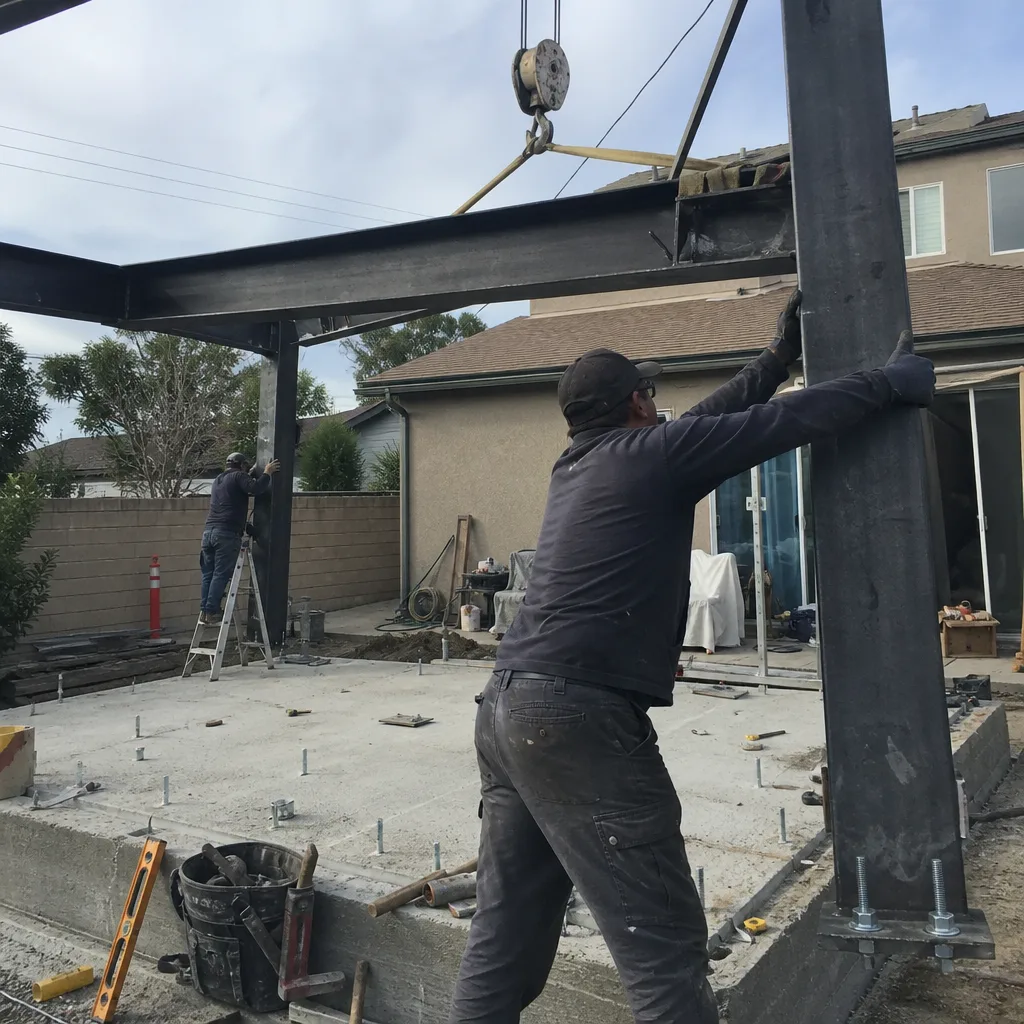
Foundation problems are the most expensive ADU failures because you often don’t discover them until the prefab unit arrives or the framer starts setting walls. Anchor bolt tolerance is the one that trips up even experienced concrete crews.
Prefab and modular manufacturers, including Mighty Buildings and Dvele, publish precise anchor-bolt layout templates. The tolerance is typically plus or minus 1/4 inch, sometimes less. A concrete crew that pours the foundation using a standard site-built template will often place bolts 1/2 inch to a full inch off, because they’re used to framers who can drill and epoxy as needed. But a prefab unit with pre-drilled steel base plates does not forgive. The unit won’t sit flat, the bolts won’t align, and you’re now looking at helical anchors, epoxy retrofits, or in the worst case, selective demolition and re-pour.
What to do if this happens:
- Stop all work and photograph every bolt position against the manufacturer’s template.
- Request a written tolerance verification from the manufacturer (they will tell you if the deviation is workable with field modifications).
- If bolts are within 1/4 inch, a licensed structural engineer can often specify an oversized base-plate washer or slotted connection.
- If bolts are further off, the engineer may require epoxy-set anchors or plate steel shims at specific spacing.
- Document everything. If your concrete subcontractor caused the error, this documentation supports a backcharge claim.
We recommend a pre-pour hold point: the prefab manufacturer’s anchor template is on site, physically verified against the form boards before concrete arrives, and signed off by whoever ordered the unit. In Placentia, where many ADUs go on compacted fill or clay-heavy soil, we also recommend a soils engineer confirm the foundation design accounts for expansion, because anchor bolts are only half the battle. A slab that heaves will move the bolts regardless of how precisely they were initially placed.
Prefab Delivery Arrived and Nothing Lines Up
It happens more than manufacturers admit. The unit arrives from Abodu or Cover, the crane or delivery crew sets it down, and a door opening is off by an inch, or the utility stubs don’t line up with the trench you dug, or the module doesn’t square with the foundation hold-downs.
First rule: do not sign the delivery receipt without a full walkthrough. The delivery driver may push you to sign quickly. Don’t. Unpack the unit enough to verify the openings, the bolt holes, the utility connection points, and the corner dimensions. Take photos of everything before the driver leaves. If the driver leaves before you’ve documented the issue, the manufacturer’s warranty position weakens significantly.
Second: determine whether the mismatch is a manufacturing defect or a site preparation error. If the foundation anchor layout was in the wrong position, that’s on your concrete contractor (see the section above). If the unit’s internal framing is out of square, that’s a manufacturer issue. If the site access route didn’t accommodate the truck’s turning radius or overhead clearance, that’s a planning failure, and it’s often the hardest to fix after the fact.
Third: get the manufacturer’s field service team involved before any field modification. Cutting, notching, or re-drilling a prefab module without written manufacturer approval voids the structural warranty. We’ve seen homeowners drill new anchor holes in a Cover unit because the foundation bolts were slightly off, and the manufacturer declined to honor any future warranty claims on that corner of the structure. The fix was a $4,000 engineered repair that could have been avoided with one phone call.
For Placentia specifically, check the delivery route before you order. Many lots in the older neighborhoods near Golden Avenue and Bradford Avenue have tight street widths, mature street trees, and overhead power lines that a modular delivery rig cannot clear. A Tuff Shed conversion delivers on a standard truck and fits almost anywhere. A full-width Dvele module does not. Route surveys cost a few hundred dollars and can be done before you sign the purchase order.
The Electrical Panel Upgrade That Nobody Scheduled
Utility connection delays kill more ADU timelines than any structural issue. The specific bottleneck is almost always the main electrical panel. Adding an ADU means adding a subpanel, a new meter if the ADU is separately metered, and potentially upgrading the main panel from 100 amps to 200 amps. That upgrade requires coordination with Southern California Edison, and in Placentia, SCE workload varies by season and crew availability.
The sequence matters more than the timing. If you upgrade the panel first, the main house loses power during the swap, which is fine if the ADU isn’t occupied yet. If you build the ADU first and then try to upgrade the panel, the existing house may need temporary power while the utility does the disconnect and reconnect, and that adds cost and scheduling complexity.
Here’s the sequence we recommend:
- Apply for the panel upgrade permit at the same time as the ADU building permit. Do not wait.
- Schedule the SCE disconnect/reconnect as soon as the panel permit is issued, not after the ADU foundation is poured.
- Complete the panel upgrade before the ADU drywall goes up, so circuits can be roughed into the ADU without a temp-power workaround.
- Have the electrician install the ADU subpanel and rough wiring during the same visit window.
- Coordinate the SCE final inspection and meter set with the city’s final inspection, because both are needed before the ADU can be legally occupied.
The panel upgrade itself typically costs $3,500 to $6,500 in Orange County depending on whether you need a 200-amp replacement, a new meter main, and whether SCE must move the service drop. That’s separate from ADU electrical rough-in. Budget it as a distinct line item from the start, and you’ll avoid a mid-project surprise that forces you to pause construction while the utility company does its thing.
Contractor Behind Schedule? Your Contract Protections in California
A contractor who slips a week is annoying but normal. A contractor who slips two months without a written explanation is a different problem, and the way you respond determines whether you retain your legal protections.
California’s Home Improvement Contract requirements under Business and Professions Code section 7159 mandate specific language in every residential remodeling or construction contract over $500. That includes, among other things, a start date, an estimated completion date, a payment schedule, and a three-day right to cancel. If your contract says “completion to be determined” or has no dates at all, you have less leverage than you think, and you should get the dates in writing now, even if the project is already underway.
When you have a contractor who is behind schedule:
- Send a written notice (email or certified mail) that references the contract’s estimated completion date and asks for a revised schedule in writing within 7 days.
- Do not withhold payment as leverage unless the contract allows it. California mechanics lien law is strict, and a contractor who has performed work can file a lien even if behind schedule. Withholding payment without contractual basis puts you in breach.
- Request a written explanation of the delay. Legitimate delays include permit stalls, utility scheduling, and material lead times. A vague “we’ve been busy” is a red flag.
- If the delay exceeds 30 days without a credible plan to resume, consult a construction attorney. The initial consultation is usually the best few hundred dollars you’ll spend on the project.
- Document everything: every conversation summary emailed after the call, every photo of job site progress or lack of it, every change order signed or refused.
In Placentia, the building department and SCE both have transparency into whether a permit is genuinely stalled or the contractor is using it as an excuse. You can call the permit center yourself. Don’t take “the city is slow” at face value.
Change-Order Disputes: The Paper Trail That Wins
Change orders are where ADU projects go from on-budget to runaway. The typical scenario: the contractor says “we found something” and does the work, then sends a bill for an additional $8,000 that was never approved in writing. The homeowner feels blindsided. The contractor feels entitled. The contract reads one way to the homeowner and another way to the contractor.
Under California law, a change order is valid only if it is in writing and signed by both parties before the work is performed. Verbal change orders are generally not enforceable against a homeowner, but the opposite is also true: if you verbally approved extra work and then refuse to pay, the contractor may have a claim for the reasonable value of the work under quantum meruit.
The paper trail you need:
- A written change order that describes the specific work being changed or added, the exact dollar amount, and any impact on the schedule. “Fix foundation” is not enough. “Install 4 epoxy-set anchors at northwest corner, re-level beam, $1,850, schedule impact 2 days” is enough.
- Photographs of the condition that triggered the change order. If the contractor says the foundation bolts are misaligned, you want your own photos, not just theirs.
- Email confirmation of the change order approval before work begins. A text message standing in for a signature is not ideal, but it’s better than a phone call.
- Receipts and invoices for any work you paid for directly, so you’re not double-billed when the contractor includes the same item in their final invoice.
If the change order is disputed after the fact, send a written dispute letter that states what was agreed, what was not agreed, and what you’re willing to pay. In Placentia, many of these disputes resolve through direct negotiation once both sides see the written record. The ones that don’t are exactly what the California Contractors State License Board complaint process exists for, and a clear paper trail makes that process dramatically faster.
When the Build Method Itself Was Wrong
This is the problem nobody wants to admit halfway through a project: the method chosen at the beginning was wrong for the lot, the budget, or the timeline. A prefab unit ordered before a site survey revealed a 6-foot grade change now requires a custom foundation the manufacturer doesn’t support. A custom site-built ADU that seemed “more flexible” is now six months behind because every trade is being scheduled separately. A Tuff Shed conversion that saved money on purchase now needs a full interior buildout that costs as much as the shed itself.
The fix isn’t always to abandon the project, but to honestly reassess what needs to change. In our experience in Placentia and surrounding Orange County:
- If site access is the problem: a modular unit that cannot reach the build location may need to switch to panelized construction or site-built framing. This is a hard conversation with the manufacturer, but it’s better than storing a module in a yard for four months while you fight the city over a crane route.
- If budget is the problem: a premium Dvele unit can be swapped for an Abodu or Cover unit with fewer custom features without sacrificing the prefab timeline advantage. Or a site-built ADU can be reduced in scope to a studio rather than a one-bedroom.
- If timeline is the problem: a custom site-built ADU may need to be re-scoped to a simpler roofline and standard window package to speed plan check and framing. The savings in time often exceeds the savings in material cost.
- If the lot itself is the problem: steep slopes, poor soil, or drainage issues that make one method unworkable usually make every method harder, but some methods tolerate site conditions better. Panelized framing on a stepped foundation often outperforms a full modular unit on a sloped lot.
The honest evaluation at this stage matters more than sunk-cost pride. We’ve helped Placentia homeowners pivot from one manufacturer to another mid-stream, and in every case the switch saved more than doubling down on the original choice would have cost.
Common Mistakes to Avoid
- Signing a delivery receipt before inspecting the unit. Once the driver leaves, warranty claims become an uphill battle. Walk the unit, photograph everything, and note any discrepancies on the receipt before signing.
- Waiting until the ADU is framed to apply for the panel upgrade. SCE scheduling in Orange County doesn’t bend to your framing schedule. Pull the panel permit with the building permit, and do the upgrade early.
- Trusting a verbal change order. “We’ll fix that and bill you later” is how $50,000 ADU budgets become $75,000 budgets. Written, signed, dated, and priced before work starts.
- Assuming the plan checker’s correction list is complete. They review what’s in the file. If a document was never uploaded, nobody will tell you it’s missing. Call the permit center and ask what’s in the file.
- Choosing a prefab unit without a site access survey. In Placentia’s older neighborhoods, the street widths and overhead lines are the deciding factor, not the lot dimensions. A $300 route survey prevents a $10,000 delivery crisis.
- Skipping the soils report on a Placentia lot with clay soil. The foundation is the one part of the project you can’t cost-effectively fix later. Pay for the geotech report.
- Using a contractor who has never worked with your chosen prefab brand. Abodu, Cover, Dvele, and Mighty Buildings each have different tolerance requirements, connection details, and installation sequencing. A contractor who’s only done site-built framing will make expensive assumptions.
When to Call a Professional
Some ADU problems are worth troubleshooting yourself: checking permit status online, reviewing your contract language, photographing job site conditions. Others need a contractor who has worked through the exact same failure before. Call a professional when the foundation pour has cured with anchor bolts out of tolerance, when a prefab unit arrives and doesn’t align, when the structural engineer’s letter contradicts the manufacturer’s spec sheet, or when a change-order dispute threatens to become a mechanics lien. These aren’t beginner problems, and the cost of a professional assessment is usually a fraction of the cost of letting the problem compound. ADU Builders in Placentia with multi-brand experience see these failures across Abodu, Cover, Dvele, Mighty Buildings, and Tuff Shed conversions, and they can tell you which fix actually fits your specific project. Classic ADU Builders offers free estimates in Placentia. Call (877) 265-5587.
Frequently Asked Questions
Electrical panel upgrades in Orange County typically cost between $3,500 and $6,500 for a 200-amp replacement, depending on whether you need a new meter main, service drop relocation, or trenching. The panel upgrade is a separate line item from the ADU electrical rough-in. Call (877) 265-5587 for an exact quote, and schedule the panel permit with the building permit to avoid timeline stalls.
Send a written notice referencing the contract’s estimated completion date, request a revised schedule within 7 days, and document every communication. Do not withhold payment unless the contract permits it; California mechanics lien law protects contractors who have performed work even if they’re behind. If the delay exceeds 30 days without a credible plan, consult a construction attorney.
Yes, a Tuff Shed conversion can be permitted as a legal ADU in Placentia if it meets building code for habitability, including insulation, electrical, plumbing, egress windows, and heating. It’s one of the most cost-efficient paths to a permitted accessory unit, but the interior buildout is where the real cost sits. Plan the interior before you order the shed.
Plan-check corrections that flag a mismatch between the structural engineer’s calculations and the prefab manufacturer’s spec sheets are the single most common stall we see. The fix is to have the engineer reconcile the two sets of drawings, which typically adds one review cycle to the timeline. Submitting a complete, aligned package the first time prevents this entirely.
Plan check for a standard ADU in Placentia typically takes 4 to 12 weeks from complete submittal to approval, depending on the building department’s workload and the complexity of the project. Prefab units with manufacturer documentation already prepared often move faster than fully custom site-built designs, but only if the submittal package is complete on day one.
Stop work, photograph every bolt against the manufacturer’s template, and request a written tolerance verification from the manufacturer before any field modification. If bolts are within 1/4 inch, a licensed structural engineer can often specify oversized plate washers or slotted connections. Further off than that, you may need epoxy-set anchors or a re-pour.
The Bottom Line
ADU project failures almost always trace back to a decision made before construction began: the wrong build method for the site, a submittal package that wasn’t aligned between engineer and manufacturer, or a utility sequence that was never scheduled. The fixes are procedural more than structural: align documentation, verify tolerances against specs, pull the panel upgrade permit early, and put every change order in writing. When in doubt, get a professional assessment before the problem compounds. A $300 inspection or a $200 consultation is cheap compared to a $10,000 delivery crisis or a $20,000 foundation repair. For Placentia homeowners weighing prefab against site-built, the right question isn’t “which product is better?” but “which method matches my lot, my budget, and my timeline?”
Need a diagnosis on your specific situation? Classic ADU Builders home is the starting point. Our team works across Abodu, Cover, Dvele, Mighty Buildings, and Tuff Shed conversions, and we also handle Bathroom Remodeling in Placentia and Kitchen Remodeling in Placentia for full interior completion. Call (877) 265-5587 to schedule your free estimate.
Written by the team at Classic ADU Builders, serving Placentia since 2015.