
Last updated October 30, 2026
The Complete Guide to ADU in Placentia
Here’s something most ADU guides won’t tell you: Placentia doesn’t play by the same rulebook as Anaheim, Fullerton, or Yorba Linda when it comes to accessory dwelling units. The city’s 1950s and 1960s tract housing, its specific R-1 lot geometries, and the way Golden State Water Company handles service connections create a set of constraints that generic California ADU advice completely misses. This guide covers what actually matters in Placentia: which lot types can support what, where the city still holds discretionary power over your project, what utilities will cost, and how to avoid the six-month dead ends that plague homeowners who follow advice written for Santa Monica or Sacramento.
Quick Answer
An ADU in Placentia is a permitted second dwelling unit on a single-family property, allowed under California state law (AB 68, AB 881, SB 13) with Placentia’s local design standards layered on top. Most single-family lots in Placentia can support a detached ADU of 800 to 1,000 square feet, a garage conversion, or a junior ADU (JADU) inside the existing home, with total project costs typically running between $180,000 and $420,000 depending on construction method and finish level. The realistic timeline from lot assessment to certificate of occupancy is 8 to 14 months, and the single biggest variable is whether your existing utility connections can handle the added load.
Table of Contents
- Placentia Lot Realities: What Your R-1 Parcel Actually Allows
- Which ADU Type Fits Placentia’s Housing Stock
- Placentia’s Design Standards: Where the City Still Has Discretion
- Utility Connections: GSWC Water, SCE Power, and Sewer Realities
- The Realistic Placentia ADU Timeline: Assessment to Certificate of Occupancy
- What ADUs Cost in Placentia: A Line-Item Breakdown
- Prefab vs. Site-Built in Placentia: Which Path Actually Makes Sense
- Financing a Placentia ADU: What Lenders Look For
Placentia Lot Realities: What Your R-1 Parcel Actually Allows
Placentia’s single-family neighborhoods were largely built out between 1955 and 1975, which means most R-1 lots fall into a predictable range: 6,000 to 7,500 square feet with homes sitting on 1,200 to 1,800 square foot footprints. That leaves side yards of 5 to 8 feet, rear yards of 15 to 30 feet, and front setbacks of 20 feet on the majority of parcels. State ADU law sets the minimums: a detached ADU can be up to 1,000 square feet (or 1,200 with two bedrooms) regardless of lot size, with a 4-foot side and rear setback, and a 16-foot height limit. But Placentia’s actual lot geometry is what determines whether those maximums are realistic.
We’ve walked dozens of Placentia backyards, and the pattern is consistent. The lots east of Kraemer Boulevard in the Alta Vista and Golden Avenue corridors tend to be shallower, with rear yards of 18 to 22 feet, which makes an 800-square-foot detached ADU tight but workable if you’re willing to accept a 4-foot rear setback and a slightly narrower unit. The neighborhoods around Tri-City Park and south toward Orangethorpe Avenue have deeper rear yards, often 25 to 30 feet, which comfortably fit a 1,000-square-foot unit with room left for a small patio. The point is this: your specific lot dimensions, not the state maximum, are what dictate the realistic footprint. A good ADU designer starts with a site survey and plots the buildable envelope before recommending any floor plan or system.
Which ADU Type Fits Placentia’s Housing Stock
Placentia’s existing homes cluster into a few recognizable styles: single-story ranch homes from the 1950s and 1960s, two-story traditional builds from the 1970s and 1980s, and a smaller stock of newer custom homes. Each housing type tilts toward a different ADU strategy.
- Detached ADU (backyard unit): Best for ranch homes with usable rear yards. This is the most common path in Placentia, and it’s where prefab systems like Plant Prefab and Boxabl shine because they minimize on-site construction time and neighbor disruption.
- Garage conversion: Placentia’s ranch homes almost universally have attached or detached two-car garages, many of which are underused. Converting an existing garage is often the lowest-cost ADU path because the foundation, roof, and framing already exist. That said, Placentia requires you to replace any lost covered parking, usually with a carport or a new garage, which adds cost and eats into the savings.
- Attached ADU (addition): For lots with narrow side yards but a generous side or rear area adjacent to the existing home, an attached ADU is often the smartest play. It shares a wall and utility lines with the main house, which reduces connection costs. This works particularly well on corner lots, which Placentia has in abundance along major corridors like Chapman Avenue and Yorba Linda Boulevard.
- JADU (Junior ADU): A JADU is a conversion of existing space inside the primary home, typically a bedroom with a separate entrance, capped at 500 square feet. In Placentia’s larger ranch homes, this is the fastest and cheapest option, often permitted in under 60 days and built for $60,000 to $120,000.
- Tuff Shed conversion: This is Placentia’s wild card. A Tuff Shed shell, properly engineered and permitted, can become a small detached ADU for under $150,000 all-in. It’s not for every lot or every homeowner, but for a rental unit or a simple guest space, it’s the most cost-efficient permitted path we know of in the city.
Our recommendation depends on what you’re actually trying to solve. Rental income? Detached or garage conversion. Multigenerational living? Attached ADU or JADU, so the family member is close but has their own entrance. Long-term value without immediate need? A detached ADU that’s sized to the lot’s full buildable envelope. We work across all four approaches, so the advice we give is based on your lot and your budget, not on which system we happen to sell this quarter. Our ADU Builders in Placentia page covers the specifics of each construction path in more detail.
Placentia’s Design Standards: Where the City Still Has Discretion
State law stripped most local control over ADUs, but Placentia, like every Orange County city, still holds discretionary power in a few specific areas. Knowing where those are will save you from a nasty surprise during plan check. The city’s ADU ordinance and design guidelines are administered by the Development Services Department, and while they can’t deny an ADU that meets state standards, they can require modifications to exterior materials, roof pitch, and window placement if the unit is visible from the street.
- Exterior finish compatibility: Placentia’s design review, when triggered, requires the ADU’s exterior to be compatible with the primary residence. That doesn’t mean identical, but it does mean the city looks at roof form, siding material, and color palette. This is one reason we use James Hardie fiber cement on our ADU exteriors as a default. It satisfies design review requirements for durability and curb appeal, and it holds up better than vinyl or thin wood composites in Placentia’s dry, occasionally hot summers and smog-adjacent air.
- Garage conversion parking replacement: Placentia enforces the state requirement that converted garage parking be replaced. A one-car garage conversion requires one replacement covered space; a two-car conversion requires two. Most homeowners choose a compact carport or a single-car garage rebuild, depending on lot constraints.
- Front setback daylight plane: If your detached ADU sits behind the primary home in the rear yard, you’re generally fine. But if the unit is visible from the front street, Placentia applies a daylight plane restriction on the street-facing elevation, which can cap the wall height at 8 feet. This matters on corner lots and shallow lots where the ADU can’t be tucked fully behind the main house.
- Fire sprinkler triggers: This is the one that catches people off guard. If your primary home doesn’t have fire sprinklers, and the new ADU is detached, you may not need to retrofit. But if the ADU is attached, or if the primary home already has sprinklers, the ADU must be sprinklered. We’ll cover the cost implications in the pricing section, but know that this single requirement can add $8,000 to $15,000 to a project in Placentia.
Utility Connections: GSWC Water, SCE Power, and Sewer Realities
Placentia’s utility landscape is specific, and it’s where generic ADU advice falls apart. The city is served by Golden State Water Company (GSWC) for water, Southern California Edison (SCE) for electricity, and the city’s own sewer system for wastewater. Each of these has its own connection process, fees, and quirks, and they don’t all move at the same speed.
On the water side, GSWC requires a new meter for a detached ADU in most cases, or a submeter off the existing service if the ADU is attached or is a JADU. The new meter route is straightforward but not fast: plan on 6 to 10 weeks from application to meter set, and budget $4,000 to $8,000 for the meter, the tap fee, and the lateral run from the street. For attached ADUs and JADUs, GSWC allows a submeter, which costs less but still requires a permit and a backflow prevention device.
Electricity is usually the gating utility in Placentia. SCE’s distribution grid in the city is older, and many residential transformers were sized for 1950s-era loads. When you add a full ADU with an electric range, a mini-split HVAC system, and an EV charger, you can easily exceed the capacity of the existing transformer on your block. SCE will require a service upgrade on your home from 100 amps to 200 amps in nearly every case, and in some pockets of the city, the block’s shared transformer needs to be upgraded, which is a process SCE controls and schedules. That transformer upgrade, when required, can add months to the timeline and thousands to the cost. We’ve seen it on the east side of the city, near the 57 freeway, where SCE’s infrastructure is oldest.
Sewer is the simplest of the three. Placentia allows a lateral connection from the ADU to the existing sewer line on the property, with a cleanout at the property line. The city’s inspection is usually scheduled within a week of the request. The main variable is the depth and condition of your existing lateral, which dictates whether you need a gravity tie-in or a pump. On flat lots, especially those along Crowther Avenue and the lower-lying areas near the Santa Ana River channel, we see grinder pumps more often than homeowners expect.
The Realistic Placentia ADU Timeline: Assessment to Certificate of Occupancy
Anyone who tells you an ADU in Placentia takes 4 months is either lying or hasn’t done one here. The honest timeline is longer, and it’s worth understanding the phases so you can plan around them.
- Site assessment and feasibility (weeks 1-3): This is a survey, a utility capacity check, a title review, and an in-person walkthrough to map the buildable envelope and flag constraints like protected trees, easements, or sloped areas.
- Design and engineering (weeks 4-10): The ADU gets drawn, the structural engineering gets completed, and the design review package is assembled. Prefab systems compress this phase to 2 to 4 weeks because the unit’s engineering is pre-approved by the state.
- Plan check and permits (weeks 11-20): Placentia’s building department turnaounds have improved, but plan check for a typical ADU still runs 6 to 10 weeks. Any design review requirements add time here. JADUs and garage conversions under 500 square feet sometimes move faster.
- Utility coordination (weeks 8-24, concurrent): This is the variable that derails timelines. GSWC and SCE work on their own schedules, and the SCE transformer issue is the biggest wild card. Start utility applications the same week you submit for permits, not after permits are issued.
- Construction (weeks 20-38): Site-built detached ADUs take 4 to 6 months in Placentia. Prefab units like Boxabl or Plant Prefab are set in 1 to 3 days, with 2 to 4 weeks of site work before and after. Garage conversions run 6 to 10 weeks.
- Final inspections and certificate of occupancy (weeks 38-42): Placentia’s building inspector schedules finals within a week, and the C of O is issued within days of passing. Plan for this, not around it.
Realistically, a site-built detached ADU in Placentia runs 8 to 12 months from first call to keys. A JADU or Tuff Shed conversion can be done in 5 to 7 months. A prefab unit splits the difference at 6 to 9 months, with the utility timeline as the primary variable.
What ADUs Cost in Placentia: A Line-Item Breakdown
Here’s the honest math for Placentia, based on projects we’ve completed and bids we’ve reviewed in the city. These are all-in ranges for a finished, permitted unit, not base prices.
- JADU (interior conversion, 350-500 sq ft): $60,000 – $120,000
- Garage conversion (400-600 sq ft, parking replacement included): $120,000 – $180,000
- Tuff Shed conversion (400-600 sq ft, on permanent foundation): $130,000 – $170,000
- Detached site-built ADU (800-1,000 sq ft): $280,000 – $420,000
- Prefab/modular ADU (Boxabl, Plant Prefab, 600-1,000 sq ft): $200,000 – $380,000
The line items that move these numbers in Placentia specifically:
- Permit and impact fees: Placentia’s building permit fees are calculated on valuation, but plan for $6,000 to $12,000 in city fees. School district impact fees don’t apply to ADUs under 750 square feet, which is a meaningful break in this city.
- Utility connection fees: GSWC meter and lateral ($4,000 – $8,000), SCE panel upgrade ($3,000 – $6,000, more if the transformer needs work), sewer lateral ($2,000 – $5,000).
- Fire sprinklers (if triggered): $8,000 – $15,000 for a full system, less for a partial retrofit.
- Site work and foundation: Placentia’s soil is mostly stable alluvial, but some pockets near the Santa Ana River have expansive clay that requires a different foundation design and adds $5,000 to $15,000.
- Interior finishes: We handle kitchens and bathrooms in-house, which removes the markup of a second subcontractor and gives you one point of accountability from shell to finishes. Our Bathroom Remodeling in Placentia and Kitchen Remodeling in Placentia experience means the ADU’s interior is held to the same standard as a primary home remodel, not a builder-grade box.
Prefab vs. Site-Built in Placentia: Which Path Actually Makes Sense
This is the decision most Placentia homeowners spend months agonizing over, and it’s where brand-agnostic advice matters. We’ve worked with Boxabl, Plant Prefab, and Tuff Shed conversions, and we’ve also done plenty of site-built projects. Here’s what the differences actually feel like in Placentia specifically.
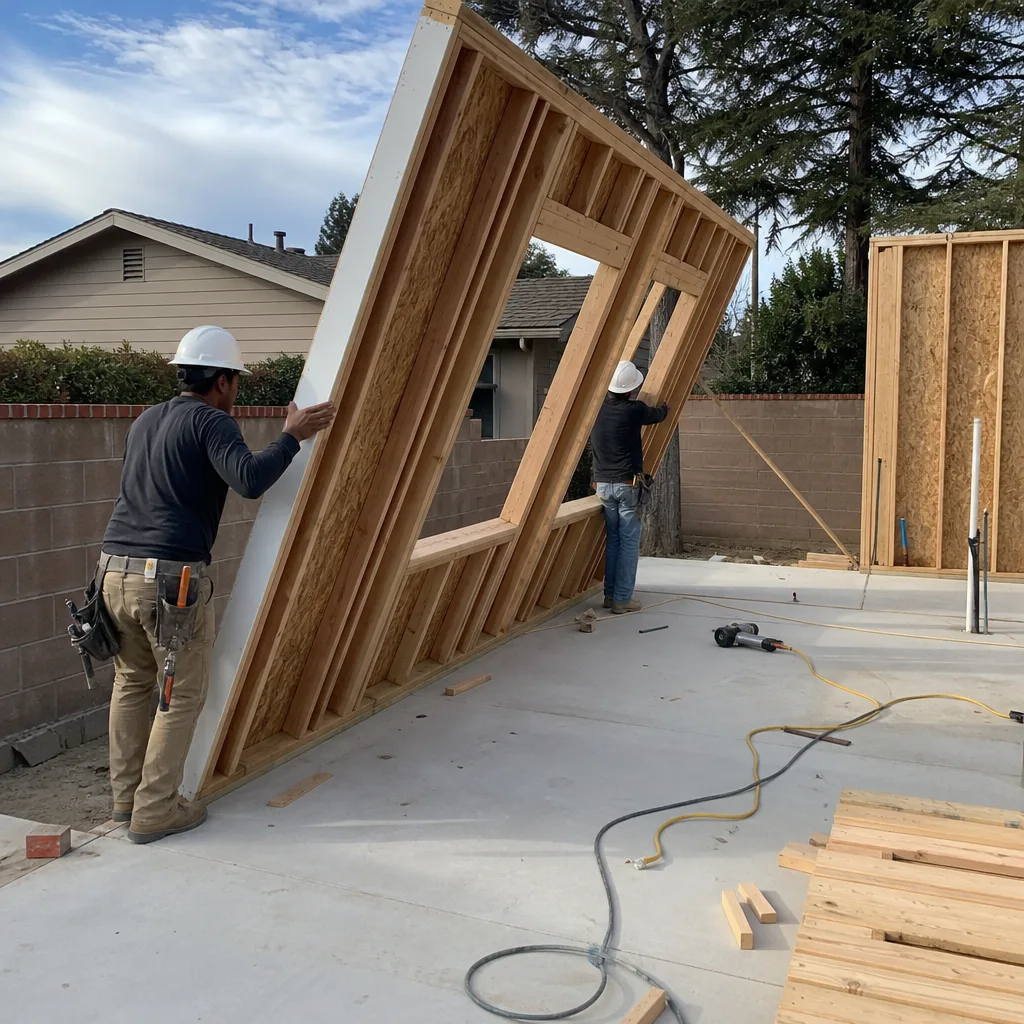
Site-built gives you complete design freedom, which matters on the irregular lots Placentia has: pie-shaped lots, corner lots with two front setbacks, lots with protected mature trees. If your lot is unusual, a custom design will use the space better than any prefab module. The trade-off is time: 4 to 6 months of on-site construction, which means 6 months of noise, dust, and workers in your backyard. For some Placentia homeowners, especially those in tight neighborhoods where the neighbors are 10 feet away, that’s a real cost.
Prefab and modular compresses the on-site phase dramatically. A Boxabl unit is set in a day. A Plant Prefab module arrives on a truck and is craned into place in an afternoon. The disruption is measured in days, not months. The trade-off is that the design is constrained by the factory’s floor plan options and module dimensions, and you’re working with a system that was designed for a range of lots, not your specific lot. That said, for Placentia’s standard 6,000 to 7,500 square foot rectangular lots, the leading prefab systems fit well, and the engineering is already done, which moves plan check faster.
Tuff Shed conversions are the category most people don’t know about but should. A Tuff Shed shell, set on a proper foundation, insulated, drywalled, and finished to code, is a legitimate permitted ADU path in Placentia. It’s the lowest-cost entry point to a detached unit, and it’s ideal for a simple one-bedroom rental or a guest house. The finish level won’t match a Dvele or Plant Prefab unit, but at half the price, it doesn’t need to.
For us, the right answer depends on what you’re optimizing for: cost, speed, design fit, or finish quality. We’re one of the few Placentia contractors who can honestly present all three paths without a hidden preference. We work with the brands you’ve already researched, and we’ll tell you which one actually fits your lot. Our Classic ADU Builders home page explains our full range and approach.
Financing a Placentia ADU: What Lenders Look For
Financing an ADU in Placentia is different from financing a primary home, and the lender’s concerns are specific to this market. You have a few main options, and the right one depends on your home equity, your credit posture, and your timeline.
A HELOC or home equity loan is the most common route for Placentia homeowners, especially those who’ve owned since before the 2020 price run-up. If you have enough equity, this is often the lowest-friction option, and it doesn’t require the ADU to generate rental income to qualify. Cash-out refinancing is similar but resets your primary mortgage rate, which is a poor choice if you locked in a low rate in 2020 or 2021.
Construction loans and ADU-specific loans are the second path. Several lenders now underwrite ADUs based on the property’s projected post-construction value, which means you may be able to borrow against the value the ADU will create, not just the value you have today. The catch is that these loans require more documentation: a fixed-price contract, a draw schedule, and a signed lease projection if you’re planning to rent. Placentia rental rates are strong enough to support these loans in most neighborhoods, with one-bedroom ADUs renting for $1,800 to $2,400 per month and two-bedrooms at $2,300 to $3,000, depending on proximity to Cal State Fullerton and the 91 and 57 freeways.
The third option is owner-builder financing, where you act as your own general contractor. We don’t recommend this for most Placentia homeowners. The city’s plan check and inspection process is navigable, but the scheduling coordination with GSWC, SCE, and the city’s inspectors is where owner-builders lose months. A single missed utility appointment can set the project back three weeks, and that’s money you’re not earning while the unit sits unfinished.
Common Mistakes to Avoid
- Starting the SCE process after permits are issued. SCE’s transformer and panel upgrades are the slowest part of a Placentia ADU, and they don’t move faster because you’re waiting. File your SCE service request the same week you submit plans.
- Assuming the state maximum is your buildable maximum. Placentia’s lot geometries, especially the shallow rear yards east of Kraemer, constrain what actually fits. Design from your actual survey, not from the state code.
- Skipping a soils report to save $2,000. The pockets of expansive clay near the Santa Ana River channel will crack a standard slab over time. A soils report is cheap insurance and required for most lenders anyway.
- Choosing a garage conversion without pricing the parking replacement. The conversion itself is affordable, but Placentia’s replacement parking requirement can add $15,000 to $30,000 depending on whether you build a carport or a full garage.
- Assuming prefab means faster overall. Prefab compresses construction time, but the permit and utility timelines in Placentia are the same as site-built. The savings is measured in months of construction disruption, not in the full project timeline.
- Using a contractor who only sells one system. Every ADU method has a best-fit lot type. If your contractor only does site-built, they’ll never tell you that a Plant Prefab module would save you 4 months. If they only do prefab, they’ll never tell you that your weird lot shape needs a custom footprint.
- Budgeting for the ADU but not the panel upgrade. Nearly every Placentia home needs the 100-to-200-amp upgrade. It’s $3,000 to $6,000, and it’s not optional. Plan for it from day one.
When to Call a Professional
If your Placentia lot has any of the following: an irregular shape, a mature protected tree, a sloped rear yard, a shallow rear setback under 20 feet, or an existing garage within 5 feet of the property line, call a contractor before you put any money into design. These are the situations where the standard ADU playbook fails, and a site-specific assessment will save you thousands and months. Similarly, if you’re weighing prefab against site-built and you’ve gotten conflicting information from different sales reps, get a second opinion from someone who has actually built with both approaches. Classic ADU Builders offers free estimates in Placentia, and we’ll walk your lot, check your utility capacity, and give you a straight answer on which path fits. Call (877) 265-5587 to schedule a site visit. We’ll tell you what’s realistic, what’s not, and what it will actually cost in Placentia, not in a generic California cost table.
Frequently Asked Questions
A permitted ADU in Placentia costs between $60,000 and $420,000 depending on type, size, and finish level, with a JADU at the low end and a 1,000-square-foot site-built detached ADU at the high end. Most detached ADUs in the city land between $200,000 and $350,000. Call (877) 265-5587 for a line-item quote specific to your lot, free.
Yes, Placentia permits detached ADUs on every single-family R-1 lot in the city, as required by state law, with a maximum size of 1,000 square feet (or 1,200 with two bedrooms) and a 4-foot rear and side setback. Your specific lot’s buildable envelope depends on its dimensions, existing structures, and any design review conditions.
Yes, garage conversions are permitted, but Placentia requires you to replace any lost covered parking with a carport or a new garage, which adds $15,000 to $30,000 to the project cost. The conversion itself is often the most cost-effective ADU path because the existing structure eliminates foundation and framing costs.
A JADU or Tuff Shed conversion in Placentia typically takes 5 to 7 months from start to certificate of occupancy, while a site-built detached ADU runs 8 to 12 months. The SCE panel and transformer upgrade timeline is the most common source of delay, so utility applications should be filed at the same time as permit applications.
Almost certainly, yes. Placentia’s housing stock is largely from the 1950s to 1970s, and most homes have a 100-amp panel that cannot support an ADU’s additional load. Plan on a 200-amp service upgrade, which costs $3,000 to $6,000, plus any transformer work SCE determines is necessary on your block.
A JADU (junior accessory dwelling unit) is a conversion of existing space inside the primary home, capped at 500 square feet, with a separate entrance and a small kitchen; an ADU is a separate or attached unit with its own full kitchen and bathroom. JADUs are faster and cheaper to permit in Placentia, and they don’t require a separate meter.
The Bottom Line
Placentia is not a generic California ADU market. Your lot size, your home’s age, your utility connections, and your specific neighborhood all change the math on what’s possible, what’s affordable, and what’s worth doing. The homeowners who succeed here are the ones who treat their ADU as a site-specific project, not a one-size-fits-all kit. That means getting a survey, starting utility applications early, understanding where Placentia’s design review still has teeth, and working with a contractor who understands the full range of ADU methods.
Placentia’s ADU opportunity is real: strong rental demand from Cal State Fullerton, a housing stock primed for conversions, and a city government that processes ADU permits more efficiently than many of its neighbors. The path through depends on honest advice and a contractor who isn’t married to one system. Classic ADU Builders offers free estimates in Placentia. Call (877) 265-5587 to schedule a site visit, or visit our ADU Builders in Placentia page for more detail on each construction path. If you’re also considering interior work on the main house, our Bathroom Remodeling in Placentia and Kitchen Remodeling in Placentia pages cover those services.
Written by the team at Classic ADU Builders, serving Placentia since 2015.